Canada's journey from scattered European colonies to an independent nation spans over 400 years of exploration, conflict, partnership, and gradual self-determination. The country you know today emerged through pivotal moments—from early French and British settlements to Confederation in 1867, through two world wars, and finally to full constitutional independence in 1982.
This timeline covers the major turning points that shaped Canada's borders, government, identity, and values, from Indigenous societies before European contact through the key political, military, and social milestones that built the nation.
What are the major historical events in Canadian history?
Canada's story revolves around a few pivotal moments that transformed scattered colonies into an independent nation. The 1867 Confederation united Ontario, Quebec, Nova Scotia, and New Brunswick into the Dominion of Canada. The 1931 Statute of Westminster granted full legal independence from Britain, while the 1982 Constitution Act brought Canada's governing document home and introduced the Charter of Rights and Freedoms.
Earlier milestones set the stage for nationhood. Samuel de Champlain founded Quebec City in 1608, creating the first permanent French settlement. The 1759 Battle of the Plains of Abraham ended French control of North America. The Canadian Pacific Railway's completion in 1885 linked the country coast to coast. The 1917 Battle of Vimy Ridge became a defining moment of Canadian military achievement and national identity.
Indigenous peoples and early settlement
First Peoples arrived in North America thousands of years ago, establishing diverse societies across the land that today represent 5.0% of Canada's population. The Haudenosaunee Confederacy in the Great Lakes region developed one of the world's early participatory democracies. The Cree and Dene in the Northwest lived as hunter-gatherers, while coastal nations preserved fish through drying and smoking.
Around 1000 CE, Norse explorers from Iceland established a brief settlement at L'Anse aux Meadows in Newfoundland. You can still visit the archaeological site today—it's a UNESCO World Heritage location. Yet sustained European contact wouldn't begin for another five centuries.
European exploration and New France
John Cabot landed somewhere on Canada's Atlantic coast in 1497, claiming the territory for England. The exact spot remains debated, though most historians believe it was Newfoundland or Cape Breton Island.
French interest followed quickly. Jacques Cartier explored the St. Lawrence River in 1534 and 1535, hearing Indigenous guides use the word "kanata" to mean village. By the 1550s, maps began showing "Canada" to describe the region.
Samuel de Champlain founded Quebec City in 1608 as a fortified trading post. The location proved ideal for the fur trade and became the capital of New France. French colonists, called habitants or Canadiens, formed crucial alliances with the Algonquin, Montagnais, and Huron peoples.
The fur trade drove New France's economy for two centuries. European demand for beaver pelts created a vast commercial network where French traders and Indigenous peoples worked as partners. Leaders like Jean Talon, Bishop Laval, and Count Frontenac built a French empire stretching from Hudson Bay to the Gulf of Mexico.
The struggle for a continent
In 1670, King Charles II granted the Hudson's Bay Company exclusive trading rights over Rupert's Land—a massive territory draining into Hudson Bay. The Company competed with Montreal-based traders for the next century, with both sides relying on skilled voyageurs and coureurs des bois who travelled by canoe and formed strong bonds with First Nations.
Britain and France fought repeatedly for control of North America throughout the 1700s. The Seven Years' War (1756-1763) proved decisive. On September 13, 1759, British forces under General James Wolfe defeated French troops led by the Marquis de Montcalm at the Battle of the Plains of Abraham, just outside Quebec City's walls.
Both commanders died in the fighting. The British victory marked the end of France's empire in America. The 1763 Treaty of Paris formally transferred New France to British control, renaming it the Province of Quebec.
British North America takes shape
The Quebec Act of 1774 showed surprising flexibility for its era. It allowed Catholics to hold public office, permitted the continuation of French civil law (while keeping British criminal law), and protected the French language and Catholic religion. The Act became one of Canada's constitutional foundations, establishing a tradition of accommodation.
When the Thirteen Colonies declared independence in 1776, more than 40,000 Loyalists fled north to British territory. About 3,000 Black Loyalists came seeking freedom, though many received poor land and later moved to Sierra Leone. Joseph Brant led thousands of Mohawk people into Canada. The Loyalists brought diverse backgrounds—Dutch, German, British, Scandinavian, and Indigenous origins, with Presbyterian, Anglican, Baptist, Methodist, Jewish, Quaker, and Catholic faiths.
The Constitutional Act of 1791 divided Quebec into two colonies:
- Upper Canada: Mainly Loyalist, Protestant, and English-speaking (later Ontario)
- Lower Canada: Heavily Catholic and French-speaking (later Quebec)
Each colony received an elected legislative assembly, marking real progress toward self-government. The name Canada became official at this time.
The War of 1812 and national identity
After defeating Napoleon's fleet at Trafalgar in 1805, the Royal Navy controlled the seas. Britain's interference with American shipping created resentment, and in June 1812, the United States invaded Canada, expecting easy victory.
Canadian volunteers, British soldiers, and First Nations warriors proved them wrong. Major-General Isaac Brock captured Detroit but died defending Queenston Heights near Niagara Falls. In 1813, Lieutenant-Colonel Charles de Salaberry and 460 soldiers, mostly French Canadiens, turned back 4,000 American invaders at Châteauguay.
Laura Secord, a pioneer wife and mother of five, made a dangerous 30-kilometre journey on foot to warn Lieutenant James FitzGibbon of a planned American attack. Her warning contributed to victory at the Battle of Beaver Dams. After Americans burned government buildings in York (Toronto) in 1813, British forces retaliated by burning the White House and other public buildings in Washington in 1814.
By 1814, the American invasion had failed. The war secured Canada's independence from the United States and largely established the border we know today. Britain built costly defence systems including the Halifax and Quebec City Citadels, which you can still visit as historic sites.
Rebellions and responsible government
Reformers in Upper and Lower Canada grew frustrated in the 1830s. Progress toward full democracy seemed too slow, and some believed Canada ought to adopt American republican values or even join the United States.
Armed rebellions broke out in 1837-38 near Montreal and Toronto. The rebels lacked broad public support, and British troops with Canadian volunteers defeated them. Several rebels were hanged or exiled, though some exiles later returned.
Lord Durham arrived from England to investigate. His report recommended merging Upper and Lower Canada and granting responsible government, where the cabinet holds power only with majority support in the elected assembly. He also controversially suggested French Canadiens ought to assimilate into English Protestant culture—a recommendation that showed complete ignorance of French Canada's determination to preserve its distinct identity.
The Act of Union merged Upper and Lower Canada into the Province of Canada in 1841. Reformers like Sir Louis-Hippolyte La Fontaine and Robert Baldwin worked with British governors toward responsible government. Nova Scotia achieved it first in 1847-48, followed by the Province of Canada in 1848-49. La Fontaine, a champion of French language rights, became the first leader of a responsible government in the Canadas.
Confederation creates a new nation
Representatives from Nova Scotia, New Brunswick, and the Province of Canada met in Charlottetown in September 1864 to discuss political union. The Charlottetown Conference launched negotiations that continued through 1867, with British support.
The Fathers of Confederation created a federal system with two levels of government. The federal government would handle national concerns like defence and trade. Provincial governments would control areas like education and health.
The British North America Act passed on July 1, 1867, creating the Dominion of Canada. The Province of Canada split into Ontario and Quebec, which joined Nova Scotia and New Brunswick. Sir John A. Macdonald, a Scottish-born lawyer from Kingston, became Canada's first Prime Minister.
Sir Leonard Tilley from New Brunswick suggested the term "Dominion," inspired by Psalm 72's phrase "dominion from sea to sea." The vision was building a powerful, united country spanning the continent. July 1 was celebrated as Dominion Day until 1982, when it became Canada Day.
Expanding westward
Canada purchased Rupert's Land and the Northwest Territories from the Hudson's Bay Company in 1869. The 12,000 Métis living along the Red River weren't consulted about the transfer, and Louis Riel led an armed uprising in response.
Riel and his followers seized Fort Garry, the territorial capital, in November 1869. Canada's future hung in the balance—how could the new Dominion reach from sea to sea if it couldn't control the interior? Ottawa sent soldiers who retook the fort in 1870. Manitoba became Canada's fifth province, and Riel fled to the United States. He was later elected to Parliament but never took his seat.
Prime Minister Macdonald established the North West Mounted Police in 1873 to maintain order and assist with treaty negotiations. The Mounties founded Fort Calgary, Fort MacLeod, and other settlements that grew into cities. Today, the Royal Canadian Mounted Police serve as Canada's national police force.
British Columbia joined Confederation in 1871 after Ottawa promised a railway to the West Coast. The Canadian Pacific Railway took years of difficult work, financed by British and American investors and built by European and Chinese labourers. On November 7, 1885, Donald Smith drove the last spike at Craigellachie, BC.
Chinese workers faced harsh discrimination after the railway's completion, including the Head Tax—a race-based entry fee. Canada formally apologized for this policy in 2006. Prince Edward Island joined in 1873, and Alberta and Saskatchewan were carved from the Northwest Territories in 1905.
The First World War
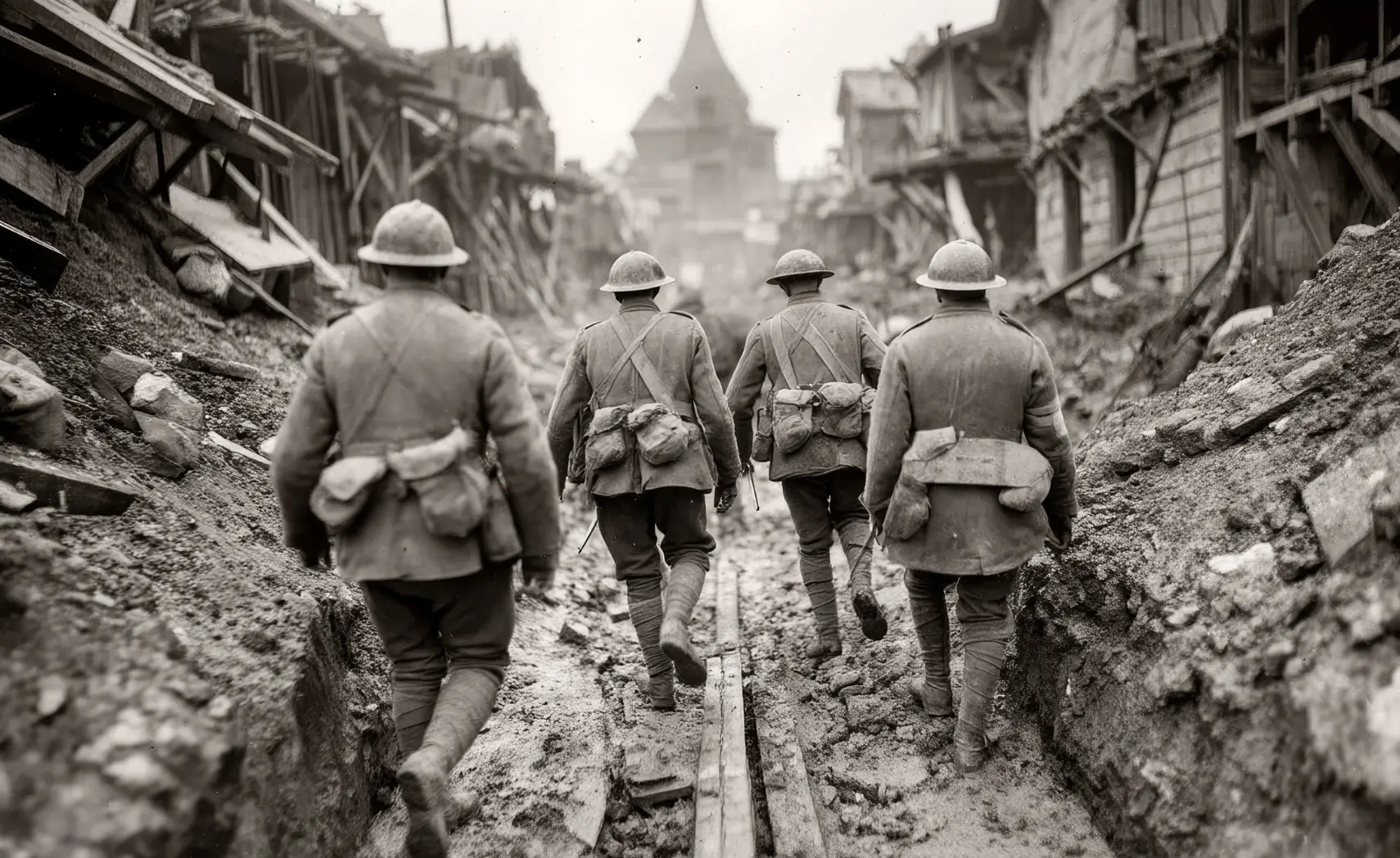
When Britain declared war on Germany in August 1914, Canada entered automatically as part of the British Empire. Over 600,000 Canadians served in the Canadian Expeditionary Force—later called the Canadian Corps—out of a population of just eight million.
Canadian soldiers earned a reputation as tough, innovative fighters. The Battle of Vimy Ridge on April 9, 1917, stands as the war's defining Canadian moment. All four divisions fought together for the first time, capturing the ridge from German forces. The victory cost 10,000 Canadian casualties but secured Canada's reputation as the "shock troops of the British Empire."
In 1918, General Sir Arthur Currie led the Canadian Corps through the final hundred days of fighting. Key victories at Amiens, Arras, Canal du Nord, Cambrai, and Mons helped force Germany's surrender on November 11, 1918. Canada lost 60,000 dead and 170,000 wounded—a staggering toll that strengthened both national pride and the desire for greater independence.
Between 1914 and 1920, Ottawa regrettably interned over 8,000 former Austro-Hungarian subjects, mainly Ukrainian men, in 24 labour camps across Canada. Britain had advised against the policy.
Women's suffrage and social change
The movement to secure voting rights for women gained momentum during the war. Dr. Emily Stowe, the first Canadian woman to practice medicine in Canada, founded the suffrage movement and led the push for change.
Manitoba granted women the provincial vote in 1916, becoming the first province to do so. In 1917, Prime Minister Robert Borden's government gave federal voting rights to nurses at the battlefront, then to women related to men in active military service. By 1918, most Canadian women aged 21 and over could vote in federal elections.
Agnes Macphail, a farmer and teacher, became the first woman elected to Parliament in 1921. Quebec was the last province to grant women the vote in 1940, after years of advocacy by Thérèse Casgrain and others. The gradual expansion of voting rights reflected Canada's evolving commitment to equality and democratic participation.
The Second World War
Nazi Germany invaded Poland in September 1939, and Canada declared war on September 10—one week after Britain. The delay was symbolic, demonstrating that Canada made its own decisions even while supporting its allies.
More than one million Canadians and Newfoundlanders served out of a population of 11.5 million. The Royal Canadian Navy grew to become the world's third-largest, protecting Atlantic convoys carrying supplies to Britain. The Royal Canadian Air Force trained over 130,000 Allied aircrew and contributed heavily to bombing campaigns over Europe.
Canadian troops fought in multiple theatres. They suffered heavy losses defending Hong Kong from Imperial Japan in 1941 and during a failed raid on Dieppe, France, in 1942. The Canadian Army helped liberate Italy in 1943-44 before turning to northwest Europe.
On D-Day, June 6, 1944, 15,000 Canadian troops stormed Juno Beach as part of the massive Allied invasion of Normandy. About one in ten Allied soldiers that day was Canadian. The Canadian Army went on to liberate the Netherlands in 1944-45, forging a lasting friendship between the two nations.
The war cost 44,000 Canadian lives. It also included the forced relocation of 22,000 Japanese Canadians from British Columbia and the seizure of their property without compensation, even though military and RCMP officials told Ottawa they posed no threat. Canada apologized for these actions in 1988.
Remembering sacrifice
Canadians observe Remembrance Day every November 11 to honour those who served and died in all wars. We wear red poppies, inspired by Lieutenant-Colonel John McCrae's 1915 poem "In Flanders Fields," and pause for silence at 11:00 a.m.
The tradition honours over one million Canadians who have served and the 110,000 who gave their lives. Parliament has recognized the significance of remembrance, and communities across Canada hold ceremonies at cenotaphs and war memorials.
Need help with Canadian history?
Studying Canadian history means connecting events across centuries and understanding how they shaped the country today. If you're preparing for a citizenship test, working through school assignments, or just want to understand Canada's past more clearly, a knowledgeable history tutor can help you make sense of the timeline and remember what matters most.