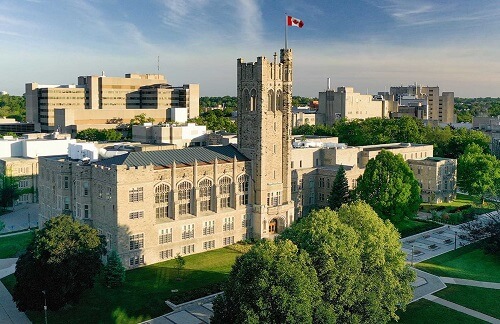
Maybe Western caught your eye at a university fair, or a friend's older sibling came home from London with stories about Homecoming. Either way, the dinner-table question has probably shifted from "Do you like it?" to "Can you get in?"
This guide walks through faculty admission ranges, how your marks get counted, required courses, extra applications, deadlines and costs, plus a few practical ways to lift your marks before offers go out.
Western University acceptance rate
Western University in London, Ontario does not publish an official acceptance rate, because it doesn't release a count of the offers it sends out. Instead, Western reports an entrance average for first-year students and an admission range for each faculty. Together, those figures give a clearer picture of how competitive it is.
So where do the percentages you see online come from? Third-party sites build their own estimates. GrantMe's overview of Western admissions, for example, puts Western's rate at 31% for 2021-22, while other sites post much higher figures using different methods.
A steadier number is the average mark of students who actually got in. According to Western's facts and figures page, first-year students entered with an average of 90.9% in 2023-24. In other words, Western is competitive, though one average can't predict your own chances.
Two terms come up again and again in Western admissions:
- Acceptance rate: the share of applicants who get an offer of admission.
- Admission average: the mark Western uses to review your application. For Ontario Grade 12 students, it comes from your top six U or M courses (more on that below).
Admission averages by faculty at Western University
Each faculty sets its own admission range, and the range moves a little every year. It depends on how many students apply and how strong the applicant group is. As a result, Western treats its posted averages as estimates, not fixed cut-offs.
You might be wondering: if my average lands in the posted range, am I in? Not automatically. Students above the range usually have a strong chance, but nothing is certain until an offer arrives. Western's undergraduate admissions site lists the current range for each program.
Engineering
Engineering is one of Western's more competitive faculties. Along with your overall average, admissions looks closely at your math and science marks. Everyone takes a shared first year, then picks a specific branch, such as civil, mechanical or software engineering, in second year.
Health Sciences
The Bachelor of Health Sciences (BHSc) is among Western's most competitive programs. Your marks matter a lot here, yet they're only one part of the decision. The program also reads a supplementary application, which comes up later on.
Ivey AEO Business
AEO stands for Advanced Entry Opportunity. It's a conditional offer that saves you a spot in the Ivey Business School's Honours Business Administration (HBA) program, which begins in third year. Meanwhile, you spend your first two years in another Western program, such as Social Science or Engineering, and keep your marks at the level Ivey sets.
AEO sits on top of your main program offer, not in place of it. The extra application steps are listed on Ivey's HBA admissions page.
Science and BMSc
Western's general Bachelor of Science lets you try subjects like biology, chemistry and physics in first year. Medical Sciences, on the other hand, is a more competitive first-year option that leads to the Bachelor of Medical Sciences (BMSc).
Students mix up BMSc and BHSc all the time (the similar letters don't help!). Here's a quick way to tell them apart:
- BMSc: lab-based science, such as physiology, pharmacology and biochemistry.
- BHSc: health from a wider angle, including public health, aging and health policy.
Social Science and Arts
Programs in Social Science, Arts and Humanities usually have lower admission ranges than Science or Engineering. Lower doesn't mean easy, though. Plenty of students apply, so a strong top six still makes a real difference.
How Western calculates your admission average
For Ontario Grade 12 students, Western picks your six best Grade 12 U or M courses and averages them into one percentage. Your required prerequisites have to be part of the six. After that, the remaining spots go to your highest other U or M marks.
Every Ontario Grade 12 course code ends in a letter that shows the course level:
- U (university): counts toward your top six.
- M (university/college): counts toward your top six.
- C (college) and E (workplace): don't count toward Western's average.
Your top six doesn't have to be all math and science. If your program has only one or two prerequisites, a strong mark in a course you enjoy, like Grade 12 World History (CHY4U) or French, can lift your average just as much.
Do Grade 11 marks matter for Western admission
Grade 11 marks aren't part of your final admission average. Even so, Western may look at your Grade 11 final marks and your early Grade 12 marks to send offers in the winter, before your year wraps up.
Early offers are usually conditional. A conditional offer means Western says yes now, as long as your final Grade 12 marks stay at the level it sets. So if Grade 11 was a rough year, it isn't the end of the story. Your final Grade 12 marks carry the most weight.
Required Grade 12 courses for Western University
Every Western program lists specific Grade 12 courses. Without them, you aren't eligible, even with a high average, and Western also looks for strength in your required courses. For that reason, it helps to plan your Grade 12 timetable while you're still in Grade 11.
The table below shows common prerequisites for Ontario students. Requirements can change from year to year, so it's worth double-checking each program on Western's admission requirements pages before you pick courses.
| Program area | Common Ontario Grade 12 prerequisites |
|---|---|
| Engineering | ENG4U, MHF4U, MCV4U, SCH4U, SPH4U |
| Medical Sciences | ENG4U, MHF4U, MCV4U, SBI4U, SCH4U |
| Science | ENG4U, MHF4U, plus science courses such as SBI4U, SCH4U or SPH4U depending on the program |
| Health Sciences | ENG4U, plus courses listed on the program page |
| Social Science and Arts | ENG4U, plus other U or M courses |
Out-of-province and international curriculum equivalencies
The top-six system applies only to Ontario students. If you study somewhere else, Western reviews your marks based on your own curriculum.
IB Diploma
International Baccalaureate (IB) students are usually reviewed on predicted scores first, then on final scores. Western matches IB courses to Ontario ones using its own equivalency guidelines, which are posted on its admissions site.
Out-of-province Canadian applicants
Students from other provinces are assessed on their own Grade 12 courses. In British Columbia, for example, Chemistry 12 and Pre-Calculus 12 can line up with Western's requirements. In Alberta, Chemistry 30 and Mathematics 30-1 play a similar role.
Western lists matching courses for each province. If your situation is unusual (say you moved partway through high school), the admissions office can walk you through it.
A-Levels and other international curricula
Students taking A-Levels, or studying in other countries, are reviewed against the standards of their own school system. Western's international admissions pages list the requirements for each country.
Supplementary applications and interviews at Western
A supplementary application is an extra form, essay or assessment that some programs ask for alongside your marks. Most Western programs don't use one. However, for programs that do, a missed deadline can rule out an otherwise strong applicant.
Ivey AEO Leadership Essay
The AEO application asks about your leadership, extracurricular activities and goals, not just your marks. Ivey explains what it looks for and posts its deadlines on the same HBA admissions page mentioned earlier. Starting early leaves time to think things through and write honestly.
Health Sciences supplementary application
BHSc applicants answer short-answer questions as part of a supplementary application. A high average alone usually isn't enough for a BHSc offer, since the written answers carry real weight in the decision. Details are on the Faculty of Health Sciences website.
Music audition requirements
Applicants to the Don Wright Faculty of Music complete an audition on top of the academic requirements. Audition dates and instructions are posted on the Don Wright Faculty of Music website. Registering early usually gives you a better pick of dates.
Transfer and mature applicant admission at Western
Not everyone applies straight from high school. Western also reviews two other groups:
- Transfer students: students who have already done some college or university study.
- Mature students: students who have spent time away from school and may not have the usual high school prerequisites.
College-to-Western pathways
If you studied at an Ontario college, some of your courses might count as credit at Western. It depends on your program and on any transfer agreements between Western and your college. Western's transfer pages explain how credits get reviewed.
University transfer GPA requirements
Moving from another university? In that case, Western looks at your university marks instead of your high school marks. The level required varies by faculty, so reaching out to the faculty you're interested in gives the clearest answer.
Application deadlines and how to apply through OUAC
OUAC stands for the Ontario Universities' Application Centre. It's the central website most students use to apply to Ontario universities, Western included. The process breaks down into three steps.
1. Create your OUAC 101 account
Current Ontario high school students apply with the OUAC 101 application. Your guidance office usually hands out login details in the fall of Grade 12. Everyone else, including out-of-province students and students returning after time away, uses the OUAC 105 application.
2. Select and rank your program choices
You can apply to several programs at several universities. The order you list them in doesn't change how Western reviews you. A mix of reach programs and safer picks gives you more options in the spring.
3. Submit your application and supporting documents on time
The main deadline for Ontario high school students falls in January, and exact dates appear on OUAC's guide to applying to Western. Supplementary applications often have their own, separate deadlines. A simple calendar with every date on it can save you a lot of stress.
Entrance scholarships and tuition at Western University
Western offers entrance scholarships based on your admission average, with a final average of 90.0% to 91.9% earning a $2,500 Western Admission Scholarship. For many of them, there's no separate form; you're considered automatically when you're admitted. Current amounts and qualifying averages are on Western's scholarships and awards page.
Domestic tuition and ancillary fees
Tuition depends on your program and on whether you're a Canadian or international student, and Western estimates first-year Ontario tuition and fees at $8,000 to $14,200. On top of tuition, you'll pay ancillary fees, which are extra charges for campus services like the student health plan and a London Transit bus pass. Current amounts, in CAD, are on Western's student fees page.
Residence and meal plan costs
Most first-year students at Western live in residence. Your cost depends on the building, room style and meal plan you choose, plus a $900 residence prepayment to secure your spot. Current prices and the rules for guaranteed residence are on Western's Housing website.
How to improve your admission average before applying
Here's the good news: Grade 12 marks build over two semesters, so there's real time to make progress. Small, steady changes usually do more than one big push the week before exams.
Identify which courses are pulling your average down
First, write down your six highest current Grade 12 marks and average them. Next, circle the one or two sitting lowest. Raising a single course from 82 to 88 adds a full point to your top-six average, which can move you into a different range.
Build a consistent study routine before final exams
Spaced-out studying, meaning short review sessions spread over several weeks, usually works better than cramming the night before. Try counting backward from each exam date and blocking off a few review sessions for heavier courses like Grade 12 Chemistry (SCH4U) or MHF4U. Little sessions add up faster than you'd think.
Get targeted help in prerequisite courses
For many Ontario students, MHF4U, MCV4U, SCH4U and SPH4U are the toughest Grade 12 courses, and they're also required for Western's most competitive programs. Working on your specific weak spots, rather than redoing the whole course, is usually the quickest route to a higher mark. TutorLyft lets students across Canada find vetted tutors for Grade 12 math and science prerequisites, with no subscription required.
Preparing for Western University admission
Your admission average is one number. It doesn't measure who you are or what you're capable of. Many students grow a lot over Grade 12, and knowing what Western looks for already puts you a step ahead, so it's completely fine to take things one semester, and one course, at a time.
If you'd like steady support in a Grade 12 prerequisite, you can find a tutor on TutorLyft who fits your goals and schedule.