
Canada's red and white flag with its distinctive maple leaf is recognized worldwide, but the country's collection of national symbols extends far beyond this single image. The beaver, the sugar maple tree, two official sports, and a coat of arms blend Indigenous heritage with colonial history to represent a young nation still defining its identity.
This guide walks you through Canada's official symbols—when they were adopted, why they matter, and what they reveal about Canadian values—plus the beloved unofficial icons that Canadians embrace as their own.
The flag and maple leaf
Canada's national flag features a red maple leaf centered on white, with red bars on each side. The flag was adopted on February 15, 1965, after decades of debate about what symbol would best represent the country. Before this, Canada used the British Union Jack for official purposes, which didn't sit well with many Canadians who wanted their own distinct identity.
The red and white colors became Canada's official colors, though historians debate exactly when this happened. Some point to King George V's proclamation in 1921, while others argue the colors only became truly official when the flag was adopted in 1965.
The maple leaf itself goes back much further than the flag. French colonists in the 1700s were the first Europeans to use it as a symbol. By the 1850s, maple leaves appeared on military uniforms, and soldiers who died serving Canada had maple leaves engraved on their headstones.
What's interesting is that the flag's design doesn't represent anything specific. The creators wanted a clean, recognizable symbol that all Canadians could identify with, regardless of their background. The eleven-pointed maple leaf was stylized just to look distinctive—those eleven points don't mean anything in particular.
Origins and adoption
The path to Canada's current flag was rocky. In 1964, Prime Minister Lester Pearson sparked what became known as the Great Flag Debate when he pushed for a new design. Some Canadians wanted to keep ties to Britain visible, while others wanted a completely fresh start.
Parliament received thousands of design submissions. After months of heated discussion, the red maple leaf design won out. On February 15, 1965, the new flag was raised on Parliament Hill for the first time, and that date is now celebrated as National Flag of Canada Day.
Symbolism in the maple leaf design
The maple leaf works as Canada's symbol for practical reasons. Maple trees grow across most of Canada, especially in Ontario and Quebec. Indigenous peoples and early settlers both relied on maple trees for syrup, and Canada now produces about 73% of the world's maple syrup.
You'll see the maple leaf everywhere in Canada—on products, company logos, sports jerseys, and even tattoos. It's become shorthand for "Canadian," recognized instantly around the world.
The beaver Canada's national animal

The North American beaver became Canada's official national animal in 1975. This might seem like an odd choice compared to more majestic animals like eagles or lions, but the beaver shaped Canada's early history more than any other creature.
From fur trade to Parliament Act
Long before Europeans arrived, Indigenous peoples valued beavers for multiple reasons:
When French and British traders arrived, they discovered that European hat makers were willing to pay top dollar for beaver pelts. The soft, waterproof fur made excellent felt for fashionable hats. This demand drove much of Canada's exploration and economic development from the 1600s through the mid-1800s.
The beaver trade nearly wiped out the species entirely. By the mid-1800s, beavers had almost disappeared from Canadian waterways. Conservation efforts slowly brought populations back, and today beavers are common again across the country.
Fun facts about the beaver
Beavers are the largest rodents in Canada, weighing up to 30 kilograms. They're famous for building dams and lodges, which they construct by gnawing down trees with their powerful teeth. A beaver's teeth never stop growing, so they stay sharp through constant use.
The beaver appears on the Canadian nickel and shows up frequently in Canadian branding. The animal represents hard work and perseverance—traits Canadians like to associate with their national character.
The maple tree Canada's national tree
The sugar maple became Canada's official tree in 1996. While ten different maple species grow in Canada, the sugar maple stands out for its distinctive leaf shape and its role in syrup production.
Why the sugar maple was chosen
Maple trees thrive in eastern Canada, particularly in Ontario and Quebec. The sugar maple's leaves turn brilliant shades of red, orange, and gold in autumn, creating the famous fall colors that draw tourists from around the world.
Indigenous peoples taught European settlers how to tap maple trees each spring. The process involves drilling a small hole in the tree trunk, inserting a spout, and collecting the sap that drips out. It takes about 40 liters of sap to make one liter of syrup, which explains why real maple syrup costs more than artificial alternatives.
The Maple Leaf Tartan, which became an official symbol in 2011, uses four colors to represent the maple leaf through the seasons—green for summer, gold for early autumn, red after the first frost, and brown for fallen leaves.
National sports lacrosse and hockey
Canada has two official national sports, which might surprise you if you only think of hockey. Parliament designated both sports in 1994 through the National Sports of Canada Act.
Lacrosse as the summer sport
Lacrosse is Canada's official summer sport, though most Canadians don't know this. The game originated with First Nations peoples across North America, long before European contact.
Different Indigenous nations played their own versions with their own names. The Onondaga called it Deyhontsigwa'ehs, the Mohawk called it Tewaaraton, and Algonquin groups called it Baggataway. Traditional games could last for days and cover huge areas of land.
Many Indigenous peoples considered lacrosse a medicine game—a gift from the Creator. The game held spiritual significance beyond just sport or entertainment.
European settlers became interested in lacrosse in the 1800s and created standardized rules. The Canadian Lacrosse Association, founded in 1867, was Canada's first official sports organization. The name "lacrosse" comes from French settlers who thought the stick resembled a bishop's crosier (la crosse).
Hockey as the winter sport
Ice hockey became Canada's official winter sport in 1994, confirming what most Canadians already believed. The modern version of hockey developed in Canada, though similar games existed in Europe.
Hockey dominates Canadian culture in a way few other sports dominate any country. The Stanley Cup, donated by Governor General Lord Stanley in 1893, remains one of the most prestigious trophies in professional sports. Canadian teams and players have shaped the game's development at every level.
Women's hockey has grown tremendously since it was added to the Olympics in 1998. Canada's women's team has won multiple Olympic medals. Para hockey (formerly called sledge hockey) has also become prominent, with Canada competing at every Paralympic Games since the sport was introduced in 1994.
The coat of arms and national colours
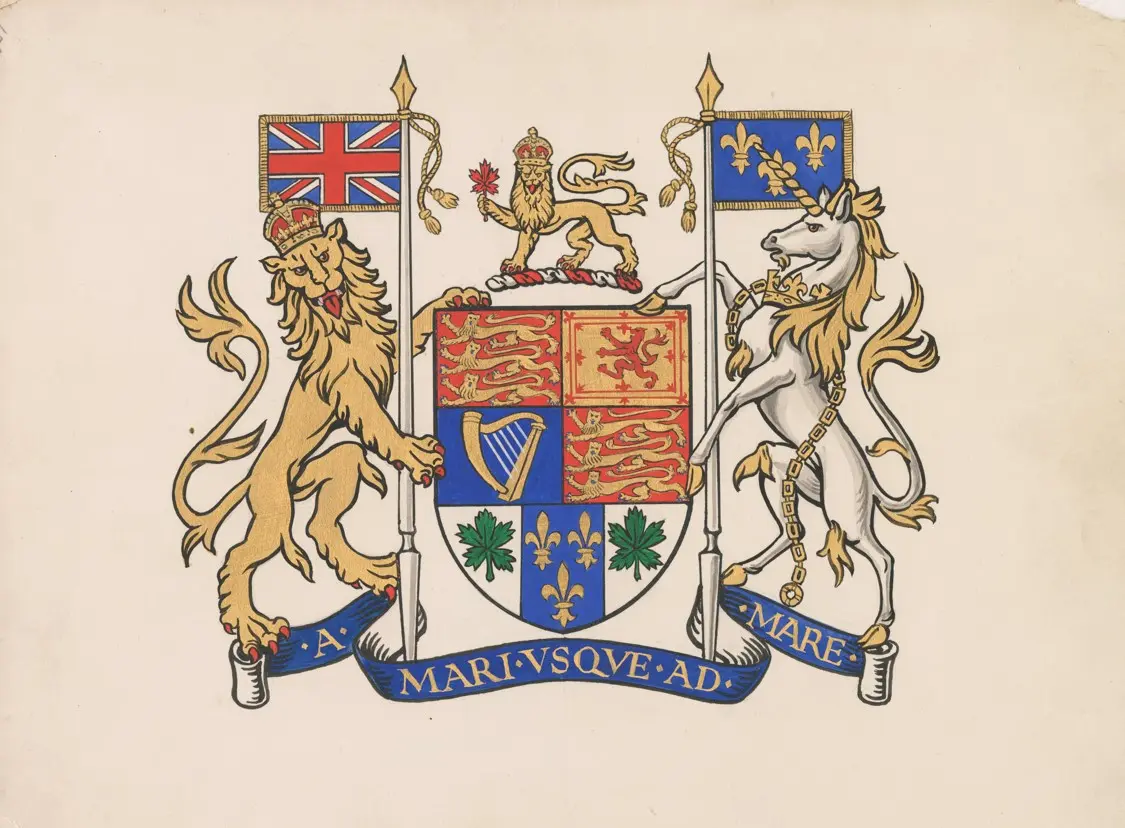
Canada's coat of arms was adopted on November 21, 1921, by proclamation of King George V. This heraldic symbol appears on passports, government buildings, and official documents.
Heraldic elements explained
The coat of arms features a shield with symbols from England (three lions), Scotland (a lion), Ireland (a harp), and France (fleur-de-lis). Three maple leaves at the bottom represent Canada itself.
An English lion and Scottish unicorn stand on either side of the shield. At their feet, you'll see roses for England, thistles for Scotland, shamrocks for Ireland, and more fleurs-de-lis for France. The Royal Crown sits on top, showing that King Charles III is Canada's head of state.
Two mottos appear on the coat of arms. "A Mari Usque Ad Mare" means "From Sea to Sea" in Latin, referring to Canada's geography spanning from the Atlantic to the Pacific to the Arctic Ocean. "Desiderantes Meliorem Patriam" means "They Desire a Better Country" and appears on the Order of Canada.
Red and white as official colours
Red and white serve as Canada's official colors. The exact date they became official is debated—some historians point to 1921, others to 1965 when the flag was adopted.
During the medieval Crusades, French and English forces used banners with red or white crosses to identify each other. Using both colors together symbolizes cooperation between Canada's French and English heritage.
Other official symbols horse tartan motto
Several lesser-known symbols also hold official status in Canada. While you won't see them as often as the flag or beaver, they're part of Canada's official identity.
The Canadian horse
The Canadian horse became the official national horse in 2002. This breed dates back to 1665, when King Louis XIV sent horses from French royal stables to New France.
Over the next century, those horses adapted to Canadian winters and hard work, developing into a distinct breed. People called them "the little iron horse" because they were small but incredibly strong and tough.
The breed nearly disappeared in the late 1800s after many were exported to fight in the American Civil War. Conservation efforts saved the Canadian horse, though only a few thousand exist today.
Maple leaf tartan
The Maple Leaf Tartan became official in 2011. David Weiser, a Toronto businessman, designed this plaid pattern in 1964 for Canada's centennial celebrations in 1967.
The pattern uses green, gold, red, and brown to show how maple leaves change through the seasons. Canadians wear it on special occasions like Canada Day (July 1) and Tartan Day (April 6).
A mari usque ad mare motto
Canada's national motto, "A Mari Usque Ad Mare," translates to "From Sea to Sea." This phrase appears on the coat of arms and refers to Canada's vast size.
The motto is particularly fitting because Canada actually touches three oceans—the Atlantic, Pacific, and Arctic. Few countries can claim borders with three different oceans.
Beloved Canadian icons beyond the official list
Some symbols represent Canada powerfully even though Parliament never officially designated them. You'll see them everywhere, and most Canadians consider them national symbols anyway.
The Mountie uniform
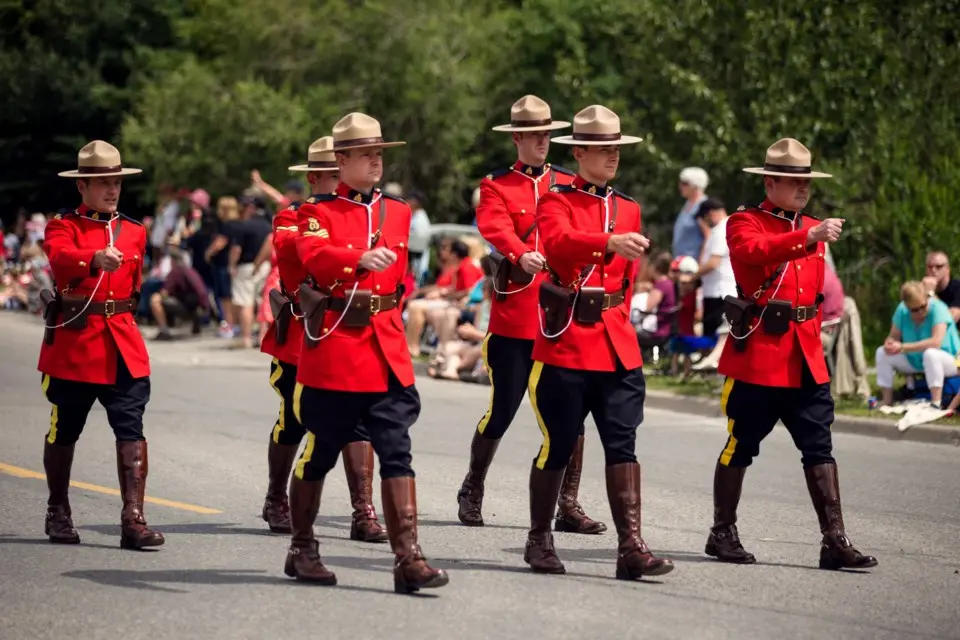
Royal Canadian Mounted Police officers, called Mounties, have symbolized Canada for over a century. The RCMP was founded in 1873 as the North-West Mounted Police to bring law and order to Canada's western territories.
Their red uniforms and wide-brimmed hats became famous through Hollywood movies about the Canadian wilderness. Today, Mounties rarely wear these ceremonial uniforms except for special events like the Musical Ride—a choreographed horse performance that tours internationally.
Maple syrup and toque culture
Maple syrup represents Canada globally, even though it's not an official symbol. Canada produces roughly three-quarters of the world's maple syrup, mostly in Quebec.
The toque—a knit winter cap—symbolizes Canada's cold climate and outdoor lifestyle. Other unofficial symbols include the Canada goose, the common loon (on the one-dollar "loonie" coin), and the moose.
Indigenous symbols like totem poles and inuksuks (stone landmarks) have become part of Canadian iconography, though this raises important questions about cultural appropriation and respect.
Why symbols matter in Canadian identity
National symbols help unite a geographically vast and culturally diverse country. They give Canadians common reference points regardless of where they live or what language they speak.
A 2013 Statistics Canada survey asked Canadians which symbols mattered most to their national identity. The Canadian Charter of Rights and Freedoms and the national flag ranked highest—more than 90% of respondents considered them important. The national anthem came in at 88%, the RCMP at 87%, and hockey at 77%.
Interestingly, less than half of Canadians (46%) considered hockey "very important," and about one in five (22%) thought it wasn't very important at all. This shows that even widely recognized symbols don't resonate equally with everyone.
Quick ways to remember Canada's symbols
Learning Canadian symbols often means memorizing lists for school or citizenship tests. A few simple tricks can help the information stick.
Mnemonics for students
Try remembering BFMHS for the main official symbols: Beaver, Flag, Maple tree, Hockey and lacrosse, Sports colors (red and white). This covers most of what Parliament has officially designated.
Another pattern to notice: most official symbols were designated between 1965 and 1996. Canada is a young country, and these symbols reflect a growing desire to establish a distinct identity separate from Britain.
Visual cheat sheet idea
Creating a visual reference helps more than reading lists. Draw or print the flag, beaver, maple tree, hockey stick, and coat of arms on one page with the year each became official written underneath.
Color-coding works well too. Use red and white to mark official symbols, and a different color for unofficial but beloved symbols like the Mountie uniform. This visual distinction makes it easier to remember what Parliament designated versus what Canadians simply love.
Classroom and study ideas for teachers and students
Understanding national symbols opens windows into Canadian history and values. Whether you're studying for a citizenship test or working on a school project, a few approaches can deepen your learning.
Discussion questions
Why did Canada choose nature-based symbols like the beaver and maple leaf instead of human figures or historical events? What does this tell you about how Canadians see themselves?
How do Canada's symbols reflect both Indigenous heritage (lacrosse) and colonial history (the coat of arms)? Do they work together to represent modern Canada, or do they create tension?
Simple in-class activities
Compare Canada's symbols with other countries. The United States has the bald eagle, England has lions, and China has the dragon. Canada's emphasis on nature—a tree, a rodent, a leaf—stands out as unusual. What might explain this difference?
Create a timeline showing when each symbol was adopted. You'll notice most came after 1960, during a period when Canada was actively building its own identity distinct from Britain. This timing isn't coincidental.